Thursday, June 5, 2014

Behavioral Learning and the Media C - E - R # 8

Below we collaborated as a group and designed a power point demonstrating behaviorist theories found in the modern media. We've learned that we do not have to look to far to realize modern media is full of examples of behaviorist theories.

More importantly, what we observed is how the application of the theory of behavior is traced to commercials. For example, the 2014 Super Bowl Commercials demonstrate nearly each theory discussed from Pavlov to Skinner.


See our presentation of behavioral theory in modern media here: Behavorial Learning and the Media

Picture courtesy of: http://vigilantcitizen.com/vigilantreport/mind-control-theories-and-techniques-used-by-mass-media/

Wednesday, June 4, 2014

Exercise on short term memory:
Today in class, we tested the element of short term memory. A text was read to us about Russia and it's culture. After the text was read, the teacher asked us to recall and type how many things we recall from the text. Interestingly, we were all about the same regarding results, however some had more and that possibly demonstrates prior knowledge of the subject.


The exercise demonstrates our use of short term memory and how we retain information that is given to us. The exercise was very interesting to say the least but also serves as a reminder about when we teach to our children. Recollection is best served when we maintain our memory base, constantly going back to the information and recalling. We learn over 90% of what we know by teaching. By repeating what we have learned, it becomes instilled and serves in long term memory.

About Russian Culture.

1.       Russians are often viewed as pessimistic, generally do not problem solve.           
2.       They are very cordial and professional with each other, addressing each, introducing each other as ‘Mr’ or Mrs.;
3.       Russians dress very well while out in public.       
4.       It is frowned upon to shake hands across an entrance
5.       Its impolite to talk and have your hands in your pocket, across your chest.
6.       Orthodox is the main religion
7.       Popular to see Western Wear/American wear during the summer months.


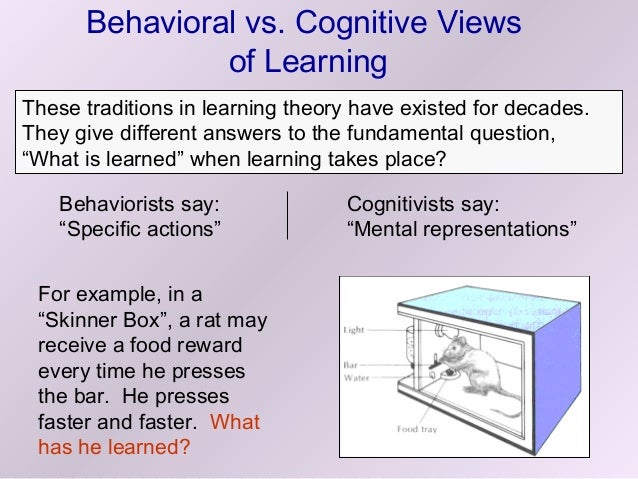
The difference between Cognitive and Behavioral learning views is complex and often misunderstood by myself including others. Early theorists like B.F Skinner believed behavior is the result of what is learned from experience. He believed that environmental influences control people. Albert Bandura believed behavior is learned from experience but feels people are more goal-oriented and have specific intentions and purposes. He argues the basis for learning is through observing others


Behavioral learning theories: explanations of learning that focus on external events as the cause of changes in observable behaviors.

Cognitive view of learning: a general approach that views learning as an active mental process of acquiring, remembering, and using knowledge.

As author Anita Woolfolk (2013) points out "According to the cognitive view, knowledge is learned, and changes in knowledge make change in behavior possible. According to the behavioral view, the new behaviors themselves are learned. Both behavioral and cognitive theorists believe reinforcement is important in learning, but for different reasons. The strict behaviorist maintains that reinforcement strengthens responses; cognitive theorists see reinforcement as  a source of feedback about what is likely to happen if behaviors are repeated or changed-as a source for information."

So what does this mean?
Reinforcement so that I understand it defined the effect that it has on behavior, it can either increase or decrease behavior. Commonly used example is by using praise. We reinforce a desired behavior from students with praise with the premise that the student will likely perform the same actions again.

Tuesday, June 3, 2014

June 3, 2014


Revisit Pavlov's Dogs. Pavlov learned that when a doctor would attempt to feed the dogs in his experiment, the dogs would salivate. Ringing a bell in conjunction with feeding the dogs proved the same response. Pavlov learned that by even just ringing the bell with the food caused the dogs to salivate. Unconditional Response.

Watson's Little Albert experiment was similar in that he introduced a toy rat to a child. The child expressed no reaction. However, when he introduced a sudden bang sound, the child reacted in fear. As he repeated the experiment, the child began to associate the loud noise with the toy rat.

BF Skinner performed similar experiments on pigeons. When the pigeons were hungry, they learned to press a button to be fed.

The experiments of Skinner and Pavlov both demonstrate incredible findings in researching the animals response to stimuli and unconditional response. While I agree with the findings and research, I question the lack of attention to the role of survival. In both cases, we overlook what I consider pivotal in understanding our very being. Since we were born, our sole function is to survive whether it be through nourishment, ie water or food.

Looking at the experiments of Skinner and Pavlov, I think we can agree that survival can be considered a primary reinforcement, better yet, an unconditional  reinforcement since it occurs naturally and does not require learning to work. Evolutionary basis to be considered since it aids in the survival of the species. Water, food, air, sleep,... primary reinforcers in order to survive. 

Tuesday, May 27, 2014

Stop and Ponder:

Cognitive Development: Gradual orderly changes by which mental processes become more complex and sophisticated

Critical periods:

Early Experience:

Later Experience:

Continuity vs. Discontinuity: A third major issue in developmental  psychology.

  •  Does change occur smoothly over time?


Nature vs. Nurture: the debate of relative contributions of inheritance and the environment is deemed one of the oldest issues in philosophy and psychology

  • Plato and Descartes supported the ideas that some ideas are inborn. 
  • John Locke on the other hand argues the mind is a blank slate at birth with experience determining our knowledge. 

Critical Periods: If learning doesn't happen during these periods, it never will. \
  • Are there critical periods where certain abilities need to develop?
  • There is no critical period that limits the possibility of language learning by adults. Adults have more learning strategies and greater knowledge of language in general to bring to bear in mastering a second language. 
  • However recent research indicates "there is a 'sensitive period' for optimal bilingual language and reading exposure and mastery"
  • There is a critical period for learning accurate language pronunciation 
Critical Periods to Know
There are many specific physical, psychosocial (also called social/emotional or relating), and cognitive development milestones that most typically developing children go through. One of the earliest psychosocial critical periods is bonding. This happens in the newborn period. Holding, soothing, and caring for your baby makes it easy for her to move through this critical period. (In understaffed, overpopulated orphanages where babies do not receive the nurturing they need in this critical period, irreparable damage can be done emotionally, making it difficult for those children later in life to form close relationships.)
"Following birth there is a period of rapid brain reorganization that is a/the critical period in brain development during which children are most sensitive to environmental stimuli.”


Decades of research show the brain may then undergo changes that could permanently alter future functionality. However, recent studies suggest it may be possible to extend critical periods, perhaps one day offering treatment options for people who are deprived of early sensory input or experience brain injury later in life.


Monday, May 26, 2014

Discovery: Technology and Planetariums

DISCOVERY: May  25,  2014.  A few weeks back, I had the opportunity to return back to my high school. Through my daughter's PTA, we arranged a trip for the elementary students to take advantage of our high school's own planetarium. While the trip may sound simplistic, it possesses a world of opportunity to view the sky in the comfort of our own school. Our district is lucky to have in it's possession one of the most advanced planetariums in the area. In fact, it's one of only two districts in the entire area to have a planetarium and observatory. The planetarium has changed since I walked the same halls over 18 years ago. The projector is a new state of the art projector which begins our journey from the school's football field to nearest planet and well beyond.

Technology through constant research and development has allowed students to see firsthand the wonders of our own solar system. Imagine what the planetarium may be like in the next 18-20 years. It's important for schools to be cognizant of these planetariums in the area. The technology is state of the art and more importantly, in line with curriculum. As schools enter further into the technology era, I feels its imperative that they consider planetariums into their budget and continue to maintain those that are luck to exist.
http://marlboroschools.schoolwires.com/Page/2749


Wednesday, May 21, 2014

Journeys: The first steps in exploring child development

Green Flag....  Let the Learning Adventure Begin

On May 20th, we came into the classroom and immediately discussed exploring blogging how to build a blog. This form of technology is completely new to me so I look forward to learning some of the 'tricks' and 'trades' on the internet. The internet is full of so many resources, many of which are not mentioned enough.  Let's hope we can learn it all in the time we have .... :)


Source: http://gregmillerprincipal.com/tag/digital-natives/


Thinklink